
The Goods and Services Tax (GST) Council has announced that Input Tax Credit (ITC) will now be available on health and life insurance policies provided by employers to their employees, a move expected to significantly reduce costs for businesses, especially MSMEs.

The Reserve Bank of India (RBI) has rejected Tata Sons' application to surrender its non-banking finance company (NBFC) licence, a decision that mandates a public markets listing for the conglomerate's holding company as it is classified as an upper-layer NBFC.

Fintech giant Paytm reports a consolidated profit of Rs 183 crore in Q4 FY26, marking a significant turnaround driven by its core payments business, growth in loans, and consumer-side profitability. The company is also prioritising investments in AI and has ruled out applying for an NBFC licence.

Bank credit to industry in India surged by 20 per cent year-on-year in July, significantly accelerating from the previous year, driven by strong expansion in sectors like engineering, gems and jewellery, and petroleum-related industries, according to the Reserve Bank of India (RBI). However, growth in gold loans, while still expanding, saw a sharp moderation.

'The Rs 35,000 crore of capex every year, I don't get to sign 35 paise out of this.'

In the next 36 months nearly 25 to 40 per cent of jobs will be under threat from AI and job losses are inevitable.

'Every period of excessive optimism eventually gives way to a correction, while periods of extreme pessimism often create the best investment opportunities.'
The RBI once again said the Tata group holding company's application for deregistration as an NBFC remains under examination.

A delayed ITR could prompt greater scrutiny, document requests or processing delays.

'It's not about individuals operating the mule accounts being more or less skilled. Instead, 'lower-level' refers to the role the individual account plays in the broader mule network.'

Several non-banking financial companies (NBFCs) are observing an increase in early-stage delinquencies within their micro, small and medium enterprises (MSME) loan portfolios, primarily driven by supply chain disruptions and escalating raw material costs exacerbated by the ongoing conflict in West Asia.

Loans against gold jewellery in India surged by an impressive 128 per cent year-on-year to nearly 4.28 trillion in February 2026, according to the latest Reserve Bank of India (RBI) data, significantly outpacing overall retail loan growth.

CRISIL Ratings predicts that the share of bank loans in NBFCs' overall borrowings will increase to 44-45 per cent by FY27, driven by elevated bond yields and softening bank lending rates.

The Indian corporate bond market witnessed a significant surge, with companies raising nearly Rs 16,000 crore in a single day, primarily led by state-owned financial institutions and NBFCs. This strong momentum, driven by improved borrowing conditions and investor confidence, is expected to persist.

'A balance had to be struck between the economic cost of taking action at this point against the need not to fall behind the curve in controlling inflation and anchoring inflation expectations.'

The Central Bureau of Investigation (CBI) is investigating the Reliance Anil Ambani Group for alleged bank loan frauds totalling 73,000 crore across seven cases. The Supreme Court is monitoring the investigation, which also involves the Enforcement Directorate (ED).

Commercial banks in India recorded their highest credit growth in two years, accelerating to 18.6 per cent year-on-year by June 27, while also mobilising nearly 7 trillion in deposits, marking the third-highest fortnightly deposit growth in 29 years.

For millions of Indians, this number has become one of the most important financial indicators. It can influence not only whether a bank approves a loan but also the interest rate you pay, the credit limit you receive and, in some cases, how quickly your application is processed.

It's not about how much you earn -- it's about how you borrow and repay.

The National Payments Corporation of India (NPCI) stated that the Merchant Discount Rate (MDR) "is distributed only amongst the UPI ecosystem, to further invest into infrastructure resilience, innovation, cybersecurity (protecting the UPI infrastructure with banks and non-banks) and customer service."

The easing of external commercial borrowing (ECB) norms by the Reserve Bank of India (RBI) is expected to significantly boost overseas fundraising by Indian companies, market participants said.

Indian listed companies experienced their fastest revenue growth in 15 quarters during Q1FY27, with combined net sales rising 18.4% year-on-year, while net profit grew 16%, primarily driven by mining, metals, and banking sectors, despite a contraction in operating margins due to higher input costs.

While the latest trigger for him stepping down could be the uncertainty around his renewal as a director at the AGM, which is otherwise a routine matter, Chandra may have been contemplating quitting for some time now because of the overall turbulence with the principal shareholder on the leadership issue.

Chandrasekaran's exit is more than a change of chairman. It represents the breakdown of the informal consensus that governed the Tata system under Ratan Tata.

Nomura has increased its March 2027 target for the Nifty 50 to 25,900, driven by strong corporate earnings and attractive market valuations, even as risks from the West Asia conflict and high oil prices persist.

The government is introducing a 0.4% Merchant Discount Rate (MDR) on UPI person-to-merchant payments above Rs 2,000, effective October 15. This move ends the zero-MDR regime, aiming to fund UPI infrastructure and sustainability, as the previous government subsidy was insufficient to cover operational costs. Payments between individuals and most everyday merchant transactions will remain free.

Brokerage firm Jefferies maintains a 'Buy' rating for Paytm, citing its dominant merchant payments platform and projected revenue growth.

Phishing sites mimicked SBI, ICICI Bank and Axis Bank to steal card details and OTPs.

'Once you're wrestling with making a merger of that scale value-accretive, you're also under pressure to keep growing the balance sheet and chasing liabilities, and other things start to slip as a consequence.'

Domestic Institutional Investors (DIIs) have significantly increased their holdings in Nifty 500 companies, reaching a record 20.9 per cent by the end of March, while Foreign Portfolio Investors (FPIs) reduced their ownership to an all-time low of 17.1 per cent, according to Motilal Oswal Financial Services.

Preferential equity listings in India reached an unprecedented 1,307 in FY26, marking a 33% increase from the previous year and reflecting a strategic choice for companies during market volatility.
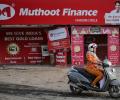
Shares of gold finance companies Muthoot Finance and Manappuram Finance hit their respective all-time highs, gaining on the BSE during Wednesday on expectation of healthy earnings. In comparison, the benchmark BSE Sensex was down 0.14 per cent, closing at 85,408.

'We strongly believe that anyone with capability and a strong work ethic should have a chance at the top job.'

'The next phase of India's IPO cycle will be defined by quality, pricing discipline and investor selectivity.'

The initial public offering of non-banking financial company Tata Capital Ltd got fully subscribed on the final day of bidding on Wednesday. The company's Rs 15,512 crore share sale received bids for 45,84,78,044 shares against 33,34,36,996 shares on offer, translating into 1.38 times subscription, according to NSE data till 13:36 hours.

LAMF allows investors to access liquidity while staying invested.

'While salary increments are moderating compared to last year, not all functions are moving at the same pace.'

Leading non-banking financial company (NBFC) Shriram Finance on Friday said Japan-based MUFG Bank would invest Rs 39,618 crore, or $4.4 billion, to acquire a 20 per cent stake on a fully diluted basis through a preferential issue of equity shares.

Students and families must stress test repayment capacity based on Indian salary standards.

The top agenda of the meeting includes a review of Tata Trusts representation on the Tata Sons board.
